code compliance
Is Your Spray Booth Electrical Equipment Class I, Div 2 Compliant?
NEC 500.5(B)(2) and NFPA 33 §6.2.1: Why Booth Listings Don't Cover Electrical Equipment Adjacent to Booth Walls
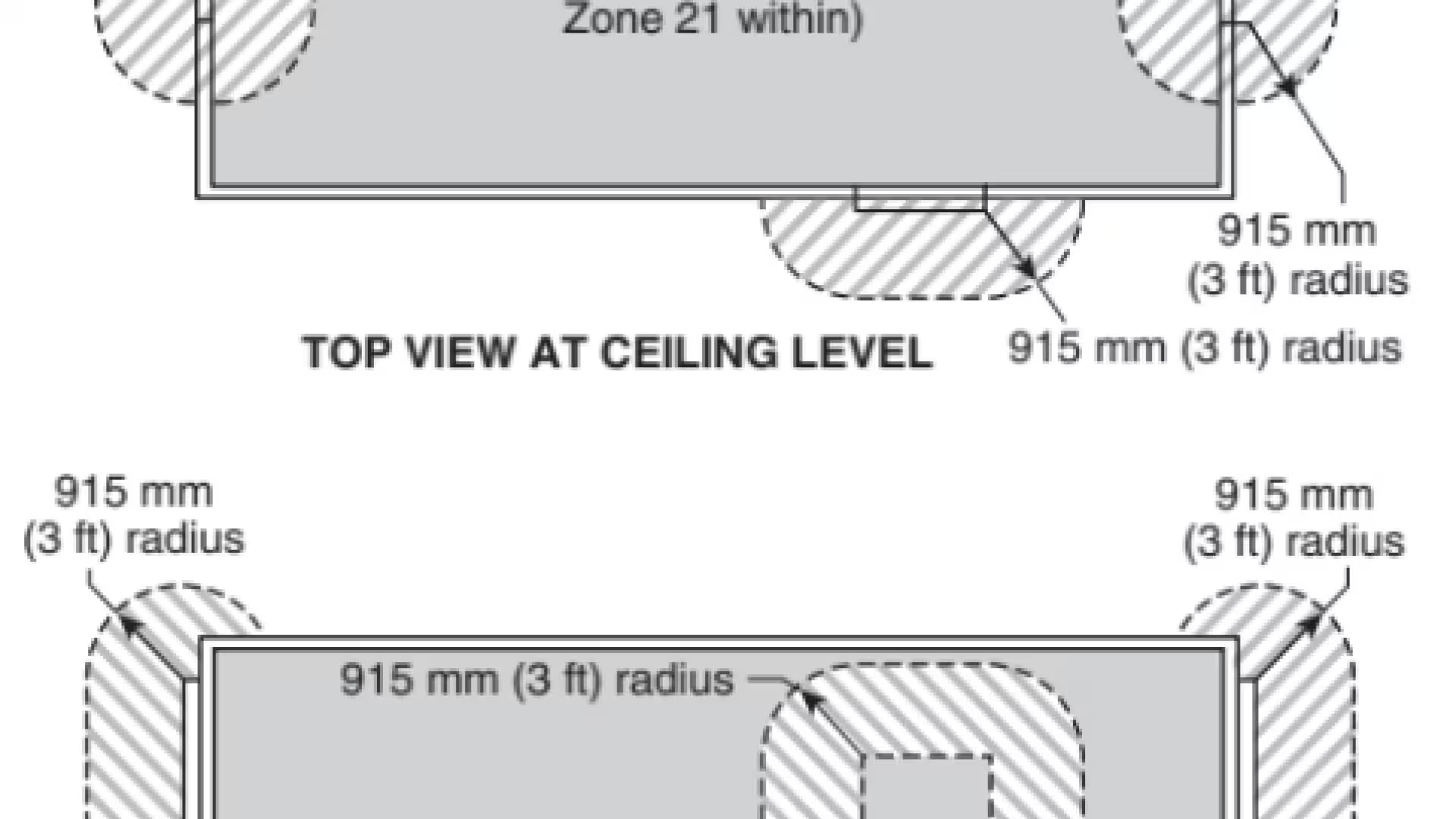
Every year, collision centers, manufacturing facilities, and industrial shops install spray booths that will pass electrical inspection but still be non-compliant. You might question if "they've installed hundreds of these across the US" how can they be non-compliant?
Codes overlap in nuanced ways.
One reason they pass inspection and install literally thousands of non-compliant booths is the National Electric Code (NEC) and NFPA 33 itself. By nature humans default to pictures. Diagrams like Figure 516.7(D)(4) (pg. 70-521) show what seems to be very clear illustrations.
My view is that these diagrams are solving one thing, but not ensuring compliance with Article 500.5 Classifications of Locations. (B)(2).
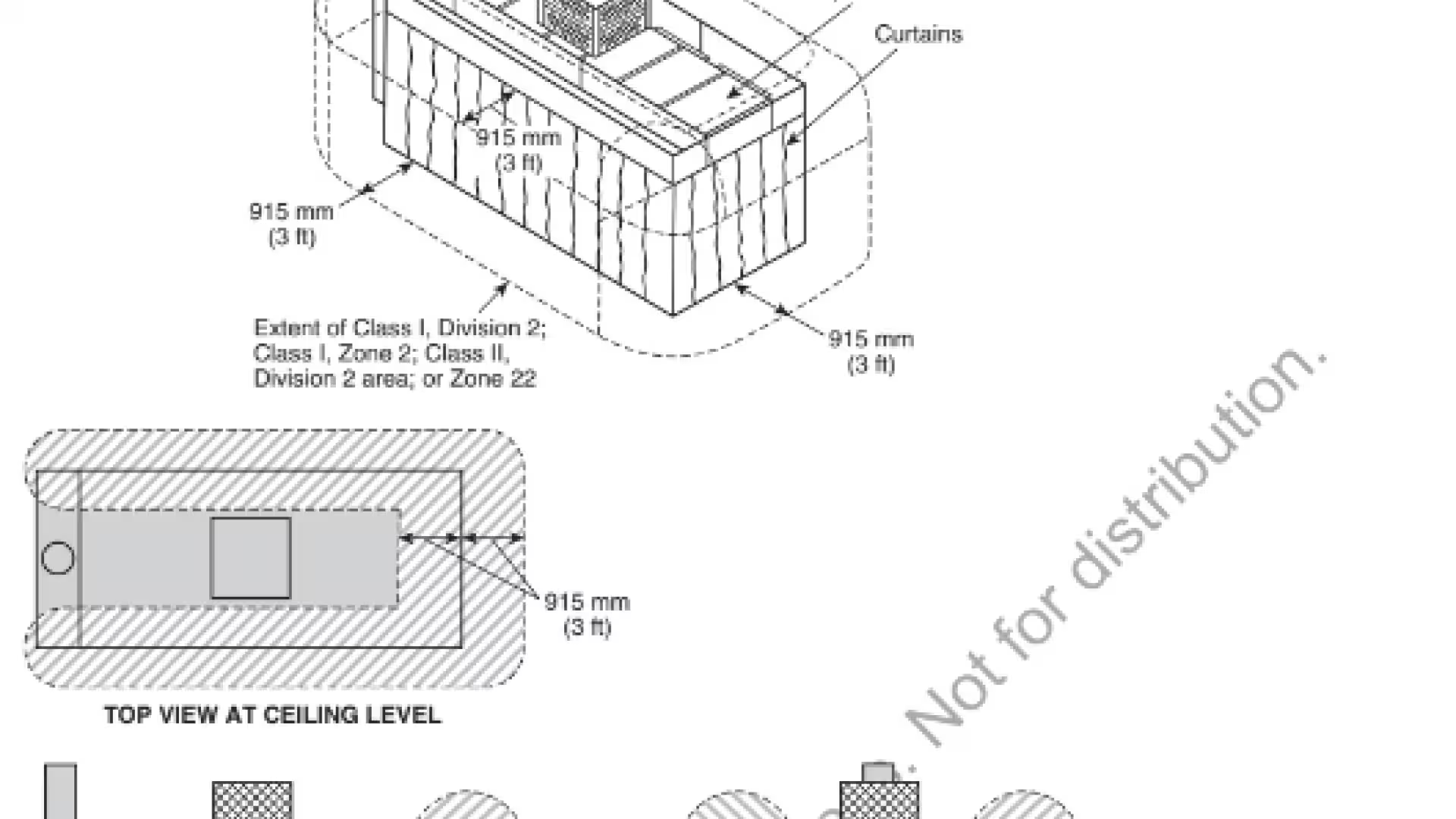
Manufacturers default to the "pictures" and fail to appreciate Table 516.5 Other articles. It's Table 516.4 that requires Article 500.5 Classifications of Locations. (B)(2). NFPA 33 also requires this overlap found at Chapter 6 Electrical and Other Sources of Ignition 6.2.1.
My guess is that these diagrams assume a "hard" "impenetrable" wall and ceiling. In reality paint booths are shipped as metal panels, roughly 24" in width. Each panel is easily puncturable by the proverbial forklift. When an accident of this nature occurs the overlap of Article 500.5 Classifications of Locations. (B)(2) is engaged.
What you should take note of is the 36" area around all openings. This is how the paint booth manufacturers "think" they get around having Class I, Division 2 electrical apparatus. If they simply place their electrical apparatus outside these areas, "they are good to go."
Not so.
In reality, only if the walls were impenetrable, i.e. reinforced concrete, or reinforced CMU (concrete masonry unit) construction do the diagrams to tell the whole code story.
The Gap Between What's Sold and What's Required
The National Electrical Code covers situations where normal operating conditions break down.
NEC 500.5(B)(2) defines Class I, Division 2 locations to include areas where:
"Volatile flammable gases, flammable liquid-produced vapors, or combustible liquid-produced vapors... might occasionally be present because of accidental rupture or breakdown of closed systems... or failure of ventilation equipment."
You may see in the referenced diagrams and articles that construction type is not mentioned. While I believe a stout reinforced concrete wall would mitigate Class I, Div 2 electrical apparatus at areas between openings, the code does not cover this scenario.
Common metal paint booth panels have seams roughly every 24" and are by their nature thin metal and puncturable.
Where the Equipment Falls Short
- Exhaust fan motors mounted on the booth structure
- Junction boxes connecting power to booth components
- Control panels with relays, contactors, and instrumentation
- Make-up air unit controls positioned adjacent to booth walls
- Variable Frequency Drives (VFDs) and motor starters in enclosures near the equipment
- Conduits
Ask your supplier: what's the electrical area classification rating on each of these components?
In my experience working with spray booth manufacturers, requests for Class I, Division 2 component ratings are typically met with references to booth listings or UL approvals. However, booth listing does not mean full compliance with all the other applicable codes.
I'm bringing this article to the public because it's not just Saima; Spray Systems. Spray Systems also shows their booths are compliant per the diagrams listed here.
It appears to me, as a registered architect, the industry has defaulted to this approach for so long, and that so many manufacturers follow this path that they think they are "all good."
They're not.
Based on the two manufacturers above, I would estimate several thousand spray booths are not fully compliant across the United States.
Others will reference the ventilation CFM and argue that vapor concentrations never reach hazardous levels during normal operation. I've heard that we "only use latex primers, and paints."
None of that matters. NEC 500.5(B)(2) requires equipment rated for the classification that exists when ventilation fails; I believe this is for where the walls are not impenetrable. However, the code does not mention "impenetrable walls, nor does it offer commentary on construction type." I hope to get this clarified with NFPA in Q2 2026.
If a motor is located in a space that becomes Class I, Division 2 when the exhaust fan stops running, that motor needs to be rated Class I, Division 2—even if the fan never stops running. There are plenty of companies producing housings such as: C3 Controls.
Why Suppliers Don't Build Compliant Equipment
Here is my take based on real experience, the economics are simple. Class I, Division 2 rated motors cost more than general purpose motors. Explosion-proof junction boxes cost more than standard boxes. Listed control panels with proper ratings cost more than commodity enclosures.
Booth suppliers compete on price. They build to the minimum that gets the equipment out the door. They rely on the diagrams that show normal operation.
They assume no one will ask the hard question.
And they're usually right. The contractor installs what arrives. The inspector sees a spray booth that looks like every other spray booth. The facility opens. Everyone moves on.
Until something goes wrong.
A Class Action Suit Waiting to Happen
I'm writing this article based on real project experience where manufacturers have resisted compliance with Article 516 when confronted with NEC 500.5(B)(2) requirements. Some have characterized technical code questions as improper interpretation. As architects of record, we're ensuring that spray booths address all applicable NEC articles, not just the diagrams showing normal operation.
Imagine the thousands of booths across America that do not have the proper enclosures at the exterior of the booth? When things work fine there is no cause for concern, but all it takes is one accident.
Should this ever occur, manufacturers will be forced to reckon with their choice in not ensuring all applicable codes are met in their pre-manufactured spray booths.
The Costs of Not Asking Your Manufacturer for Class I, Div 2 Rated Electrical Equipment
Now you're facing:
- Remediation costs to replace non-compliant equipment with properly rated components
- Project delays while you source Class I, Division 2 equipment (which has longer lead times)
- Finger-pointing between the booth supplier, contractor, and owner over who pays
- Re-inspection fees and potential permit complications
- Liability exposure if the facility had opened without correction
All because nobody asked one question before the equipment shipped.
The One Question That Protects You
Before you issue a purchase order for spray booth equipment, send this request in writing to your supplier:
"Please provide written documentation confirming the Class I, Division 2 rating of all electrical equipment—including motors, fans, junction boxes, controls, and instrumentation—located within or adjacent to the classified hazardous area zones that will exist when ventilation systems are not operating."
Note the specific language: "when ventilation systems are not operating." This forces the supplier to address NEC 500.5(B)(2) directly. They can't hide behind normal operating condition diagrams.
If they can provide the documentation, you're protected. Specify that equipment in your purchase order. Hold them to it.
If they can't provide the documentation—or if they dodge the question with vague assurances about their booth being "listed" or "approved"—you have your answer. That equipment will not pass inspection in a jurisdiction that enforces the NEC correctly.
What "Listed" and "Approved" Actually Mean
Booth suppliers love to reference their equipment's listing or approval. UL, ETL, FM—the labels suggest compliance with everything. They don't.
A spray booth listing typically covers:
- Fire safety of the booth enclosure
- Airflow and filtration performance
- Interlock functionality
- Compliance with NFPA 33 for the booth itself
It does not mean that every electrical component shipped with the booth is rated for the hazardous area classification where it will be installed. The listing covers the booth. It doesn't cover the motor the supplier bolted to the side of it.
This distinction matters. An inspector isn't checking whether your booth has a listing. They're checking whether the electrical installation complies with the NEC. Those are different questions.
The Engineer's Role—and Its Limits
Your electrical engineer designs the system correctly. They reference NEC Article 516. They draw the classified zones per Table 516.4. They specify Class I, Division 2 equipment in the areas that require it.
The plans get approved. The permit is issued.
But the engineer doesn't select the spray booth. The owner or contractor does that, usually based on price and lead time. The booth arrives with whatever electrical components the supplier chose to include.
If those components don't match what the engineer specified, the installation doesn't comply with the approved plans. The engineer did their job. The supplier didn't do theirs. And now it's your problem.
Enforcement Varies—But the Code Doesn't
Some jurisdictions enforce NEC 500.5(B)(2) rigorously. Others barely look. You might install non-compliant equipment and never get caught.
But the code requirement exists regardless of enforcement. If a fire or explosion occurs, investigators will pull the NEC and NFPA 33. They'll examine whether electrical equipment was properly rated for its installed location. "The inspector didn't catch it" is not a defense.
And enforcement is tightening. As inspectors receive better training on hazardous locations, the spray booth installations that passed five years ago may not pass today. The equipment that "everyone uses" may be the equipment that everyone has to replace.
Protecting Yourself: A Checklist
Before your next spray booth installation:
-
Review your electrical plans. Confirm the engineer has shown classified zones per NEC 516.4, including areas that become Class I, Division 2 when ventilation fails per NEC 500.5(B)(2).
-
Request equipment documentation from your booth supplier. In writing, ask for Class I, Division 2 ratings on all electrical components located within or adjacent to classified zones.
-
Compare the documentation to your approved plans. Every piece of electrical equipment in a classified zone shown on the plans must have a corresponding rating from the supplier.
-
Specify compliant equipment in your purchase order. Don't assume—require it contractually.
-
Verify equipment ratings on delivery. Check nameplates before installation. It's easier to reject non-compliant equipment at the loading dock than to remove it after installation.
-
Document everything. If the supplier can't provide ratings, document that you asked. If they provide assurances but no documentation, document that too. If something goes wrong later, you want a paper trail showing you did your due diligence.
The Bottom Line
Spray booth manufacturers build equipment that works. They don't necessarily build equipment that complies with the NEC for the hazardous location where it will be installed.
That compliance gap exists because suppliers design for normal operating conditions, while the code requires equipment rated for failure conditions. Until you ask the question directly—and get documentation, not assurances—you won't know whether your booth equipment will pass inspection.
One question. In writing. Before you sign the purchase order.
Your booth supplier can't answer it? Find one who can.
Trevor Pan is a registered architect in Arizona, Texas, New Mexico, Arkansas, and Louisiana, specializing in commercial and industrial facilities including automotive collision centers, spray application facilities, and hazardous occupancy spaces. Contact Trevor Pan Architects at (480) 277-3499 or [email protected].